
The 17th Ebola virus disease outbreak was declared in the Rwampara and Mungbwalu health zones, in Ituri Province in the eastern part of the country, on May 15, 2026. The Minister of Public Health, Hygiene, and Social Welfare reported that analyses by the National Institute of Biomedical Research (INRB) confirmed positive cases in the samples collected. The Bundibugyo strain was identified as the causative agent. The epidemiological report of May 20, 2026, notes 160 suspected deaths, 61 confirmed cases, 671 suspected cases, and 1,261 contacts.
The Minister of Public Health, Hygiene, and Social Welfare made an emergency visit to Bunia on Sunday, May 17. The objective was to strengthen the response to this epidemic. Dr. Samuel Kamba assured that the DRC government is hard at work to improve the response. Technical sampling teams have also been deployed.
Quote:
“against the Ebola virus…” (here is an archived link to the publication)
Full verified translation of the quote
Here is the English translation of what the author of the video says in Lingala, one of the national languages of the DRC: “…They say there’s a pandemic and people are dying. My brothers, don’t die like this. With this pandemic, drink hot water all the time. I don’t have it on camera. Go share this! You who are watching this video and scrolling by, your brothers are losing their lives. We have guava leaves; people from Ituri, Mahagi, Mungbwalu, and Ariwara, share this widely. We need: cinnamon, hibiscus, cloves, red onions, lemon, ginger, and black peppercorns. My darlings, buy these ingredients in large quantities; make even a baby swallow 2 tablespoons. Let everyone drink this. Those who love tea, put that aside for now and take this instead. Treat the illness first and avoid death. People are calling me from everywhere, especially in Mongbwalu…”.
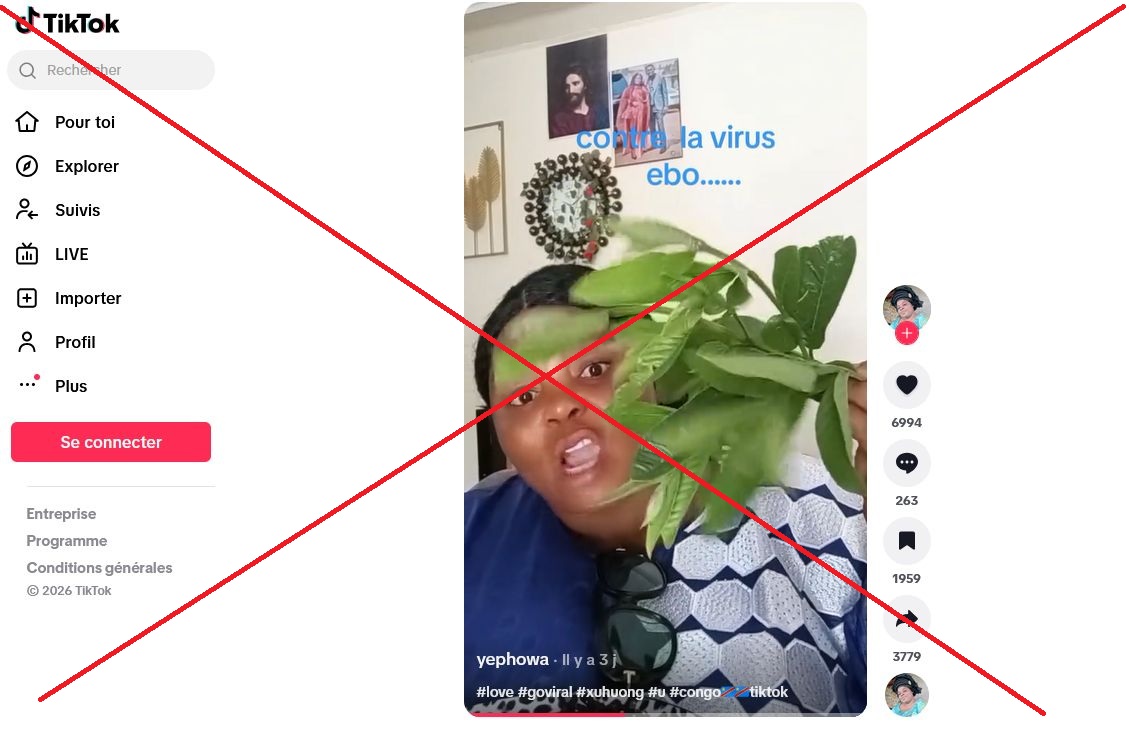
Screenshot captured by BALOBAKI CHECK
Facts :
This claim seemed suspicious to us, especially since a quick Google search using the keywords “recipe, guava leaves, cloves, red onion, lemons, against Ebola”yielded no conclusive results. We then sought to determine whether there is a likely cure for the Bundibugyo strain that reemerged in the DRC in 2026. We found that there is currently no approved treatment for the Bundibugyo virus.
In response to comments from some followers regarding the consequences of using this recipe—after they had tried it without success—the TikToker then posted a second video, explaining that the reported dizziness was likely due to the use of a large amount of cinnamon in the preparation. We wrote to the administrator of this TikTok account who posted the video on Thursday, May 21, 2026, to inquire about the scientific evidence supporting her recipe; she did not respond. On this account, she primarily produces videos of treatments using traditional remedies. We then wanted to learn about the strategies used in the DRC during the resurgence of Ebola virus disease in 2012. The Bundibugyo strain had been reported in Isiro in the Haut-Uélé province. Virologist Professor Jean-Jacques Muyembe, Director General of theNational Institute for Biomedical Research (INRB), states that in 2012, only public health measures had made it possible to contain the disease.
“Ebola epidemics in the DRC are caused by the Ebola Zaire strain, for which we have developed all our control strategies. Except in 2012, when the Ebola epidemic was caused by a new virus from Uganda, which is therefore called the Bundibugyo virus. We brought that outbreak under control using only public health measures, which mainly involved isolating Ebola patients, but also protecting healthcare workers by providing them with gloves and disinfectant, as well as ensuring safe burials,” he explains in this interview.
Professor Muyembe affirms that “although there is not yet an approved drug or vaccine, we believe we can control and contain this disease by applying the same methods we used during the 2012 Isiro outbreak. Therefore, there is no reason to panic; we must work together, and the public is urged to trust the Ministry of Health .”
After declaring theongoing Ebola outbreak (Bundibugyo strain) a public health emergency of continental concern, the Africa Centers for Disease Control and Prevention (Africa CDC) reports that work is underway to develop vaccines against this disease. Dr. Jean Kaseya, director of this African research institution, explains that three avenues are currently being explored: the vaccines Hervé Beaumère developed in France, Shadox developed in the United Kingdom, and VSV-BD-BV developed in Texas.
Ebola in DRC: The Virus in the mirror of myths and misinformation
Miracle cures and misinformation: why should we be wary?
Regarding the herbal concoction proposed as a miracle cure by the internet user, epidemiologist Dr. Valery Biduaya believes it has symptomatic treatment properties. It does this by relieving sore throats, fatigue, and even the common cold. However, it does not destroy the virus. The epidemiologist fears that by giving credence to this traditional treatment, community transmission, the spread of misinformation, and delays in patients seeking care will increase.
“This remedy may provide some relief from certain symptoms such as sore throat, fatigue, or the common cold due to the natural properties of its ingredients, but it does not destroy the Ebola virus and is never a substitute for medical care. Placing too much faith in this type of treatment can have several serious consequences: delays in patients seeking care at health centers, increased risk of family and community transmission, worsening of the patient’s condition due to lack of appropriate care, and the spread of misinformation during the epidemic,” he warns.
As preventive measures, epidemiologist Dr. Valery Biduaya recommends that the public: “to avoid any contact with the bodily fluids of sick people, to promptly report any suspected cases to health authorities, to wash hands regularly, to accept vaccination when it is offered, to avoid handling wild animals found dead, and to follow health protocols during funerals.”
In conclusion: the claim that a decoction made from guava leaves, red onion, cinnamon, hibiscus, cloves, ginger, and black peppercorns protects against Ebola has no scientific basis.
Writing by Glodi Mirembe – Editing and translation by : Ange K. Adihe
Our sources—You too can verify this information:
- Link to the declaration of the new Ebola outbreak in the DRC
- Link on the new Bundibugyo strain
- Link to the May 20, 2026 report
- Link to the health minister’s visit
- Link to the archived publication
- Link to the search using keywords
- Lien sur le traitement curatif de Bundibugyo
- Lien de la deuxième vidéo de la Tiktokeuse
- Lien sur la résurgence d’Ebola en 2012
- Lien sur l’INRB
- Lien de l’interview du Dr Muyembe
- Lien vers la déclaration d’Africa CDC
- Lien sur les candidats vaccins explorés
FRENCH VERSION


0 Comments